Artist Profile - Michelangelo
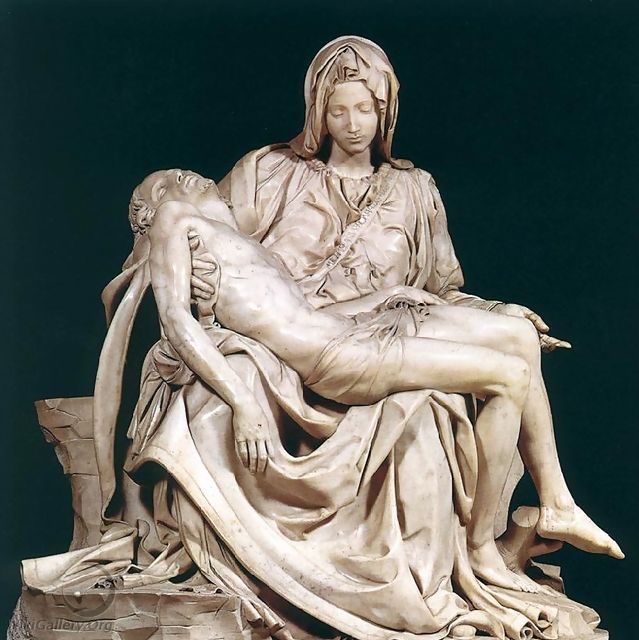
The artist I chose to profile was Michelangelo Buonarroti.
Michelangelo di Ludovico Buonarroti Simoni was born on March 6th, 1475 in Caprese, Italy. His father was Ludovico Buonarrto Simoni and mother was Francesca di Neri di Miniato del Sera. His father was a podesta, which is a title for some high officials in Middle Aged or Renaissance Italy. Michelangelo had four brothers - Leonardo, Buonarrato, Giovan, and Sigismondo. Michelangelo's mother died when he was six years old.
In his life, Michelangelo never married. However, he had a few relationships in his life theorized to be romantic. The most recognizable ones would be a woman named Vittoria Colonna, with whom he had a very close friendship and bond with. Many theorized these two were romantically involved in some ways though they acted as mostly friends. The other most notable relationship would be a man named Tommaso de' Cavalieri. It is not confirmed if the two were romantically involved; it is mostly theories. They had a close bond but there is evidence to suggest a possible paternal relationship or a romantic one. One or the other.
Michelangelo Buonarroti's formal education was largely made from apprenticeships. The most notable ones being with painter Domenico Ghirlandaio and, later, he studied sculpture in the gardens of Lorenzo de' Medici. He learned in the midst of Humanists, and with his mentor as Lorenzo the Magnificent.
During Michelangelo's lifetime, many notable events happened. In 1498, Savonaroia, a dominican monk, was tried, hanged and burned. This was one year before the Pieta was finished. In 1501, Raphael took under the St. Nicholas of Tolentino altarpiece in Citadel Costello. In 1512, the Medici family, a prominent house, returned to Florence. In 1515, Francis I became King of France. In 1527 there was a sack of Rome that sent Michelangelo into hiding. For reference, Michelangelo died in 1564.
Some struggles Michelangelo faced would first and foremost be the fall of the Florentine Republic - he was forced into hiding because of this, for a while. Another would be how much his work would get suspended. Sometimes, his works would be halted in the middle, and he would have to return to them later. A large one, however, would be how he struggled painting the Sistine Chapel ceiling. He complained his wrists would hurt, as would his neck. Nonetheless, he persevered.
Michelangelo worked mostly with sculptures, paintings, sketches, and architecture. The movement this artist was apart of the Renaissance period. Michelangelo's most notable works would be the Pieta, David, and Ceiling of the Sistine Chapel. There is so much more but those are just three to mention.
I've always loved Michelangelo and his work. No matter what it is, it always proves to be magnificent, regal, and rich in everything. Two of my favorites wold the Libyan Sibyl and the Drunkenness of Noah.

The piece features a mythological Greek figure, someone who watched over the oracle of Zeus in the Libyan desert. The word Sibyl roughly translates to Prophetess. Over history, Sibyls were often found in many myths but the Libyan Sibyl is a specific one. The Libyan Sibyl foretold a riddle, 'the day where that which is hidden shall be revealed'.
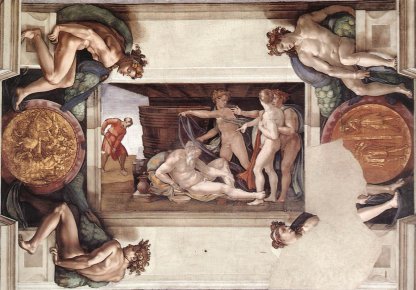
Most people would be surprised by my saying The Drunkenness of Noah is one of my favorite pieces. But I like this piece because of the theology behind, the morality, the vulnerability, the unfiltered view on humanity. The piece features a story from the Old testament, as many of Michelangelo's paintings do, the story of Noah's sons right after the flood. After the flood, and the celebration, Noah planted a vineyard. After tasting of the wine, he got very drunk and lay uncovered in his tent. The raw and brutal nature of humanity is portrayed when Noah's son Ham saw the nakedness of his father. His other two brothers, Shem and Japeth, covered the nakedness of their father with a garment, and kept their gazes turned from their Father's vulnerability. But Ham laughed and taunted Noah in all his drunkenness. Later, when Noah awoke and realized what Ham had done to him, he cursed his line. The significance of the story is the fact that the Earth had just been wiped clean of evil and malice by the flood, that was it's purpose. But somehow, evil had fallen through the cracks and into Ham's heart. Here, human evil shows itself again after the flood.


Comments
Post a Comment